Corporate Governance Policy
The Bank has established a Corporate Governance Policy, together with related guidelines, to promote good corporate governance in alignment with internationally and nationally recognized corporate governance principles and regulatory requirements. The Bank’s corporate governance policy covers key principles, including the treatment of shareholders and stakeholders, disclosure and transparency, board responsibilities, internal control and risk management, as well as codes of conduct and business ethics. We have assigned the Corporate Governance Committee to oversee the regular review of our policies and related practices to ensure their continued appropriateness and compliance with applicable regulatory requirements. The committee also ensures that good corporate governance principles are effectively implemented in the Bank’s business operations and reports on its performance results to the Board of Directors.
Corporate Governance Structure
Board of Directors
The Board of Directors, which is the highest authority of the Bank, is responsible for establishing, reviewing and determining the Bank’s vision, mission, policies, goals, business direction, and both short-term and long-term business strategies. It has the authority to approve the Bank’s strategies, business plans and various policies, while also overseeing the Bank’s operations to ensure compliance with laws, the Bank’s regulations, and the resolutions of the shareholders’ meeting.
committees
Various committees are appointed by the Board of Directors to review, provide recommendations, monitor, and oversee operations in accordance with the mandates assigned by the Board of Directors. The committees regularly report on the performance of their duties to the Board of Directors. The Bank has five committees, as follows:
- The Board of Executive Directors: Responsible for carrying out tasks as assigned by the Board of Directors, including the consideration and approval of loans, debt restructuring, investments, and undertaking other business activities of the Bank. It is also responsible for reviewing other matters that require approval or consent from the Board of Directors or the shareholders’ meeting resolutions, as specified by law or the Articles of Association of the Bank.
- The Audit Committee: Responsible for ensuring the accuracy and adequacy of financial reporting, reviewing and evaluating the internal control and internal audit systems to ensure they are appropriate and effective. The Audit Committee also reviews and approves the audit plans, monitors compliance with applicable laws and regulations, and ensures the internal control and internal audit systems are effective and efficient. Additionally, the committee reviews compliance with laws and regulations, considers related party transactions or those incidents with potential conflicts of interest to ensure they align with legal and regulatory requirements, and evaluates the selection and coordination with the Bank’s external auditors.
- The Nomination and Remuneration Committee: Responsible for establishing policies, criteria and procedures for the selection of the Bank’s directors, members of subcommittees, and senior executives from the level of Executive Vice President upwards. The committee considers, selects and nominates individuals for these positions to the Board of Directors. Additionally, the committee establishes policies and criteria for remuneration and other benefits, including the amount of remuneration and benefits provided to directors, members of subcommittees, and senior executives from the level of Executive Vice President upwards.
- The Risk Oversight Committee: Responsible for overseeing the Bank’s risk management to ensure it is systematic, consistent, effective, efficient, and aligned with the Bank’s strategic plan and overall risk management policies.
- The Corporate Governance Committee: Responsible for supporting the operations of the Bank’s Board of Directors in the areas of good corporate governance and sustainability by ensuring the adoption of good corporate governance and sustainability principles in practice. This includes reviewing and ensuring the established sustainability strategies are appropriate for the Bank’s business, as well as providing recommendations to the Board of Directors on issues related to environmental, social, and governance (ESG) risks and opportunities.
Roles, Duties and Responsibilities
The Bank clearly distinguishes the roles, duties and responsibilities of the Board of Directors and management and distinctly separates the positions and authorities of the Chairman of the Board of Directors, the Chairman of the Board of Executive Directors, and the President. These three positions are not held by the same individual, in order to ensure effectiveness and transparency in the Bank’s governance and internal operations. Management is responsible for managing and driving the Bank’s business in accordance with the policies and strategies approved by the Board of Directors and for achieving the objectives set by the Board. This includes determining operational guidelines, action plans, systems and work processes, as well as ensuring that human resources and other resources are adequately and appropriately managed to support operations. In addition, management is responsible for carrying out other duties within the scope of the authority delegated by the Board of Directors.
Board Structure and Promotion of Board Diversity
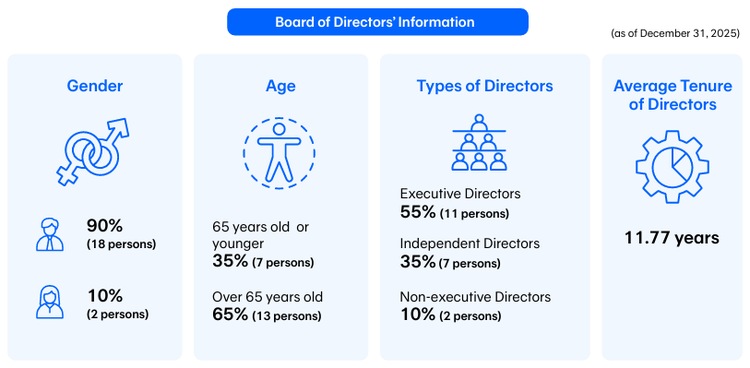
The Bank determines the structure, size and composition of its Board of Directors to be appropriate to its business context and in compliance with regulatory requirements. At least one-third of the total number of directors must be independent directors to ensure an appropriate balance of power. Independent directors are required to possess qualifications prescribed by the Bank, which are equivalent to those stipulated by the Securities and Exchange Commission (SEC). The Bank has assigned the Nomination and Remuneration Committee to be responsible for the nomination and selection of suitable individuals to serve as directors, in accordance with established processes and criteria. In this regard, the Committee considers candidates’ knowledge, competencies and professional skills that are beneficial to the Bank, utilizing a Board Skill Matrix and the Director Pool database of the Thai Institute of Directors. Consideration is also given to candidates’ business experience and compliance with regulatory qualification requirements. The list of qualified candidates is submitted to the Bank of Thailand for approval prior to being proposed for appointment as directors.
Promotion of Board Diversity
The Bank places strong emphasis on board diversity, recognizing that a diverse Board of Directors brings varied, broad and well-rounded perspectives across all key dimensions relevant to the Bank’s business operations. This, in turn, supports effective corporate governance and contributes to sustainable long-term performance. The Bank has established a Board Diversity Policy to serve as a guiding principle for the nomination and selection of directors. Under this policy, the Nomination and Remuneration Committee is required to consider directors’ qualifications with due regard to diversity in areas such as skills, knowledge, expertise, experience and educational background, without restrictions based on gender, race, religion or culture. In addition, the Bank periodically reviews the appropriateness of the Board’s structure, size and diversity, and reports the results to the Board of Directors for consideration and the determination of appropriate courses of action.
Efficiency of the Board of Directors
Meetings
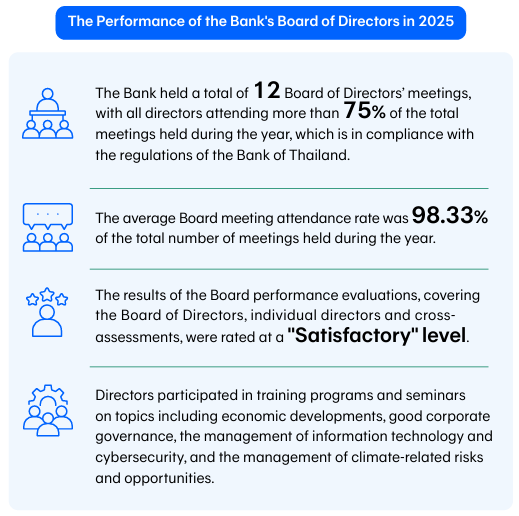
The Bank holds meetings of the Board of Directors on a monthly basis. All directors have the duty and responsibility to attend every Board meeting, or at least 75 percent of the total number of meetings held during the year, in accordance with the regulations of the Bank of Thailand.
Performance Evaluation
The Bank conducts an annual performance evaluation of the Board of Directors to provide directors with an opportunity to review their performance over the past year and to use the evaluation results to further enhance their performance, thereby improving the overall effectiveness of the Board. The Board performance evaluation comprises: (1) self-assessment, an evaluation of the Board of Directors’ collective performance and each director’s individual performance; and (2) cross-assessment, which is an evaluation of other directors’ performance. The Company Secretary is responsible for distributing and collecting the evaluation forms and submitting them to the Nomination and Remuneration Committee for compilation and analysis. The summarized evaluation results are then reported to the Board of Directors for acknowledgment.
Development of Directors
The Bank places strong emphasis on the continuous development of directors’ knowledge and competencies. The Bank encourages all directors to attend training programs that are beneficial to the performance of their duties as bank directors, such as the Director Certification Program and the Director Accreditation Program organized by the Thai Institute of Directors Association. In addition, the Bank encourages directors to enhance their knowledge and acquire new skills that contribute to the Bank’s business development through participation in training courses and seminars organized by both internal and external institutions.
Evaluation of the Performance of Duties and the Determination of Remuneration for Senior Executives
The Bank’s Board of Directors is responsible for evaluating the performance of the Executive Chairman and the President, using an assessment form based on the guidelines for the CEO assessment form disseminated by the Stock Exchange of Thailand and approved by the Bank’s Board of Directors. The main evaluation topics cover areas such as leadership, strategy formulation, strategy execution, financial planning and performance, and relationships with the Board of Directors, among others.
The Nomination and Remuneration Committee is responsible for determining appropriate remuneration for senior executives at the levels of Executive Vice President, Senior Executive Vice President and above, and for proposing such remuneration to the Board of Directors for approval. The remuneration determination is linked to the Bank’s performance indicators over both the short-term and long-term, as well as to the individual performance of each executive. The performance indicators cover financial, customer, operational efficiency and process development, and human capital development dimensions. Examples include return on assets (ROA), revenue growth, loan growth, asset quality, customer satisfaction, and cost management. In addition, consideration is given to those performance indicators reflecting the Bank’s competitiveness relative to other financial institutions and leading companies in Thailand, such as overall return on equity.
Corporate Governance Culture
The Bank promotes and supports all members of the Board of Directors, executives and employees to understand and adhere to the principles of good corporate governance, strictly comply with policies and practices that foster effective governance, and embed it as part of the organizational culture. The Bank communicates these policies and practices to all members of the Board of Directors, executives and employees. Additionally, the Bank encourages the Board of Directors and senior executives to participate in training or seminars on topics related to good corporate governance. It also supports executives and employees in enrolling in various courses that enhance their understanding of working under the principles of good corporate governance, such as anti-corruption, anti-money laundering and combating the financing of terrorism and the proliferation of weapons of mass destruction, business ethics, market conduct, and personal data protection. The Bank’s continued commitment to improving corporate governance is reflected in the 2024 Annual Corporate Governance Survey of Listed Companies conducted by the Thai Institute of Director, in which the Bank received a rating of “Excellent.”