Management Approach
The Great Green Transition Project
To empower Thai businesses to adapt to changes from policies, regulations and trade rules related to the environment and climate change, the Bank launched the Great Green Transition project aimed at creating opportunities for market expansion and increased business value through the integration of knowledge, innovation and financial tools. Through this initiative, we organized seminars to exchange knowledge and perspectives on transitioning to a green business with experts and senior executives from leading organizations. The Green Transition Academy training program was also designed to provide in-depth information and practical training to businesses seeking environmental sustainability. Furthermore, we set up a Facebook page, the Great Green Transition by Bangkok Bank, as a resource for information on environmental and climate change trends, progress on measures and regulations impacting businesses, and examples of organizational management for low-carbon business transitions.
Responsible Lending
We manage ESG risks in our loan approval process by integrating ESG issues, including climate change, as appropriate to the nature of the transaction and related risks. This prevents negative impacts while simultaneously seeking opportunities to create positive social and environmental impacts from the activities the Bank supports through lending. We have established a responsible lending policy to guide our loan considerations, taking into account ESG factors. This policy and its guidelines have been communicated to all relevant departments, while regular training on ESG risks and climate change is conducted for all employees. This equips employees with a thorough understanding so that they can provide valuable advice to customers. We also continuously improve our loan approval process to better accommodate environmental and climate risks. Furthermore, we provide opportunities for stakeholders to give feedback on potential ESG impacts from our lending activities through various contact channels. This information is then used to support future reviews of the responsible lending policy and guidelines.
Metrics and Compensation of Executives
The number of knowledge sharing activities and the amount of green and transition loans are used, as part of an annual performance evaluation, to determine compensation of executives in related HR and business units.
Business Loans and Project Loans
We integrate ESG issues into the business loan and project loan assessment processes starting from the Know Your Customer (KYC) and Customer Due Diligence (CDD) procedures. This includes checking for money laundering and financing of terrorism and the proliferation of weapons of mass destruction, as well as checking for negative ESG history and news such as severe environmental and natural resource destruction, labor or community rights violations, corruption, unfair trade practices, intellectual property infringement, and data privacy rights violations. Every loan application is carefully and rigorously reviewed under the Bank's established credit underwriting standards, along with appropriate control and monitoring mechanisms commensurate with the risk level, to prevent risks related to compliance, customer's ability to repay the loan and the Bank's reputation.

Guidelines for Project Finance
We place high importance on projects that may cause severe adverse social and environmental impacts, such as mining, power plants and building infrastructure systems. Therefore, the Equator Principles are applied as part of the credit underwriting process and we require comprehensive environmental and social due diligence for each project. This includes consideration of greenhouse gas emissions (Scope 1 and 2) data and the attainment of environmental and social management certifications at either the national or international level, such as the ISO 14001 Environmental Management System, ISO 45001 Occupational Health and Safety Management System, or OHSAS 18001. Additionally, the management of environmental and social risks and impacts is also a factor for consideration in the credit underwriting process. The Bank’s guidelines for project finance are outlined as follows:
-
Project loan applications are classified according to the level of environmental and social risks and impacts into three categories:
- Category A refers to projects that may have high environmental and social impacts.
- Category B refers to projects that may have moderate environmental and social impacts.
- Category C refers to projects that may have low or no environmental and social impacts.
-
In cases where the project loan application is classified under Category A or Category B, a comprehensive assessment of the environmental and social risks and impacts must be conducted in accordance with the criteria set by the Bank, as follows:
- The Customer is required to manage environmental and social risks and impacts of the project and submit an Environmental and Social Impact Assessment (ESIA) report for the project that meets acceptable standards.
- The Bank’s officers must review the customer’s environmental and social impact assessment report and other related documents to identify significant environmental and social risks and impacts, as well as measures to prevent and mitigate these risks and impacts. The results of such a review will be used as information for considering credit underwriting and determining the terms and conditions of the loan as appropriate.
The Bank stipulates that project loan applications which may pose potential environmental and social impacts must include appropriate and sufficient measures to prevent and mitigate such impacts. For loan applications categorized under Category A, an independent expert in environmental and social matters must be engaged to review the risks and impacts assessment as well as the environmental and social risk management system of the project. Furthermore, the Bank requires higher approval criteria based on the level of risk. After a project loan has been approved, the Bank’s officers will regularly monitor compliance with the environmental and social impact mitigation measures during the credit limit review process throughout the term of the project financing.
Project Finance Results in 2025
| Risk Category | Number of Projects |
| Category A | 2 |
| Category B | 7 |
| Category C | 0 |
| Total | 9 |
| Outcome | Number of Projects |
| Approved | 9 |
| Declined | 0 |
| Under consideration | 0 |
Personal Loans
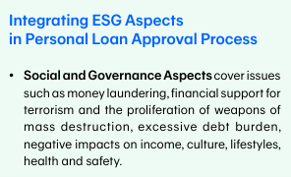
To support a sustainable solution to Thailand's household debt problems, we are committed to adhering to the Bank of Thailand's responsible and fair lending principles. These principles emphasize managing lending throughout the debt cycle, prioritizing customer benefits from before or during debt, through debt repayment difficulties and even during legal action. This is done in conjunction with providing customers with essential information and warnings to encourage responsible financial behavior and better financial discipline. We incorporate ESG aspects into personal loan applications from the Know Your Customer (KYC) to Customer Due Diligence (CDD) procedures. Furthermore, loan applications must not violate any laws or have a severe negative impact on society and the environment. We also consider the borrower's ability to repay the debt, aligning it with their income level according to the Bank's criteria. This takes into account sufficient residual net income after loan repayments to ensure a decent standard of living and prevent excessive debt that negatively affects their quality of life, particularly for vulnerable groups such as the elderly, low-income earners and first jobbers.
We monitor customers' spending and debt repayment behavior after loan approval to use the information to review loan amounts and ensure they align with their ability to repay. We also monitor economic and social situations including natural disasters and pandemics that may affect customers' ability to repay, in order to find timely ways to assist those affected.
Sustainable Financial Products
The Bank has developed a diverse range of financial products to promote environmentally-friendly activities and behaviors. These products help business and individual customers adapt and make a smooth transition to a low-carbon economy and society. These efforts contribute to Thailand’s progress toward achieving the United Nations Sustainable Development Goals and the Net Zero goal, while also contributing to achievement of our own Net Zero goal.
Environmental Financing for Corporate Customers
- Loans for Renewable Energy We support investment in the production and transmission of electricity from renewable energy sources both domestically and internationally, including solar power plants, wind power plants, hydropower plants and biomass power plants.
- Loans for Electric Mass Transit Systems We support projects for the construction of electric mass transit systems to facilitate public transportation, reduce traffic congestion and reduce greenhouse gas emissions generated from travel by fossil fuel-powered vehicles.
- Loans for Environmentally-friendly Transportation We provide loans for the purchase of zero-emission vehicles and loans for the production of electric buses to business customers abroad.
- Loans for Environmentally-friendly Real Estate We offer loans to domestic and international real estate projects that have received internationally recognized certification of green and environmentally-friendly building standards.
- Loans for Energy and Environmental Conservation We encourage large-sized domestic and international businesses to operate in an environmentally-friendly manner and use energy efficiently by providing loans for various activities such as material reuse/recycling, biological waste treatment, energy efficiency improvement, the use of renewable energy and energy storage systems, etc.
Sustainability-linked Loans
We incentivize large corporate customers, both domestic and international, to achieve their sustainability goals through sustainability-linked loans. Customers will receive special benefits if they successfully meet their defined sustainability targets, such as reducing greenhouse gas emissions, increasing energy efficiency and reducing resource consumption.
Loans for Environment and Sustainability to SME Customers
- Loans for Solar Panel Installation We promote investment in solar cell system installations for entrepreneurs to help them reduce electricity costs and avoid greenhouse gas emissions.
- Loans Promoting Environmentally-friendly Activities We encourage SME to conduct business in an environmentally-friendly manner and support the country's Bio-Circular-Green (BCG) Economy policy through providing loans for investment in reducing energy consumption, managing waste for recycling or reuse and producing or using bio-materials to replace chemicals that create environmental problems.
- Bualuang Green Financing for Transition to Environmental Sustainability We support the business sector, especially SME, in transitioning to environmental sustainability through loans with special interest rates for investment in three areas: greenhouse gas emissions reduction, climate change adaptation and pollution reduction.
- Bualuang Transformation Loan We have been providing loans with special interest rates to SME that need to enhance liquidity to recover from the impact of the Covid-19 pandemic, enabling them to continue operations and invest in adapting to changes in the new era. Support is provided for investments in three areas: operating environmentally-friendly businesses, operating businesses using digital technology and operating businesses using future innovations.
- Employment Promotion Loan We provide loans with special interest rates to SME to promote the maintenance of employment levels for entrepreneurs who have been experiencing liquidity issues since the Covid-19 outbreak, under the condition that they maintain at least 80 percent of their existing employment level.
Loans for Environment and Sustainability for Individual Customers
We support Bualuang Poonphol Green Loan for environmentally-friendly, energy efficient and accessible housing improvements for the elderly and the disabled. We collaborate with partners to offer a variety of benefits to customers who apply for the Bualuang Poonphol Green Loan. We also support Bualuang Green Home Loans for the purchase of new residential properties with rooftop solar panel systems from various real estate projects with our partners. We also provided loans for the purchase of condominium units or flats for low income earners.
ESG Bonds
We have consistently played a key role in supporting fundraising for projects and activities that benefit the environment and society, both from the public and private sectors. This is achieved through acting as an underwriter for ESG bonds in accordance with international standards, including green bonds, social bonds, sustainability bonds and sustainability-linked bonds. At the same time, we also provide advisory services on issuing green bonds and sustainability bonds to businesses seeking to raise funds through the capital market.
Mutual Funds for Sustainability
We support businesses that are socially- and environmentally-responsible, and demonstrate good governance. In collaboration with our affiliated asset management company, we continue to select and offer investment products that promote sustainability. As of the end of 2025, the Bank offered a total of 16 ESG funds, representing net assets under management of Baht 28,245.69 million.
| Mutual Funds | Investment Strategies | Investment Policies | AUM Unit: Million Baht |
| • B-KIND Fund | ESG Integration | Invest in companies that support social responsibility in four areas: environmental, social, good governance and anti-corruption. The fund donates 40 percent of its income from fund management fees to foundations or social development organizations. | 264.16 |
| • Bualuang Thai Equity CG Fund (B-THAICG) • Bualuang Siriphol Corporate Governance Fund (BSIRICG) • Bualuang Siriphol Corporate Governance RMF (BSIRIRMF) |
ESG Integration | Invest in companies with good corporate governance by considering the CG Scoring from the Thai Institute of Directors or other relevant agencies. The Bualuang Thai Equity CG Fund (B-THAICG) also considers companies that are certified as members of Thailand’s Private Sector Collective Action Against Corruption (CAC). |
5,290.64 |
| • Bualuang Sustainable Investing Portfolio (B-SIP) • Bualuang Sustainable Investing Portfolio RMF (B-SIPRMF) • Bualuang Sustainable Investing Portfolio • Super Savings Fund (B-SIPSSF) |
Thematic Investing | Invest in companies worldwide that are sustainably managed with attention paid to social and environmental impact at every step of the production of products and services. | 3,840.90 |
| • BCAP Clean Innovation Fund (BCAP-CLEAN) | Thematic Investing | Invest in securities or financial instruments of businesses engaged in environmentally sustainable innovations such as clean energy, electric vehicles, the circular economy, waste management and energy storage. | 462.89 |
| • Bualuang Top-Ten Thailand ESG Fund (B-TOP-THAIESG) • Bualuang Equity Thailand ESG Fund (B-EQ-THAIESG) • Bualuang Sovereign Instruments Thailand ESG Fund (B-SI-THAIESG) • Bualuang Mixed Thailand ESG Fund (B-MIXED-THAIESG) |
ESG Integration | Invest in securities of companies recognized for their environmental or sustainability achievements, as well as in bonds and debentures such as green bonds, sustainability bonds, or sustainability-linked bonds. | 9,816.17 |
| • Bualuang Equity Thailand ESG Extra Fund (BEQD-TESGX) • Bualuang Mixed 70/30 Thailand ESG Extra Fund (BM70-TESGX) • Bualuang Mixed Dividend Thailand ESG Extra Fund (BMDIV-TESGX) • BCAP SET Thailand ESG Extra Fund (BCAPSETTHAIESGX) |
ESG Integration | Invest in securities of companies selected by the Stock Exchange of Thailand for their outstanding environmental or sustainability performance, disclosure of greenhouse gas emission reductions, good governance, as well as in bonds and debentures such as green bonds, sustainability bonds, or sustainability-linked bonds. | 8,570.93 |
Engagement with Customers on ESG Issues
Engaging with Partners
and Customers on ESG Issues The Bank prioritizes engaging with partners and customers on issues related to ESG opportunities and challenges through offering financial products that support activities that create a positive environmental and social impact, providing advice and guidance to customers and organizing activities to promote sustainability or ESG knowledge, such as seminars and workshops, as well as disseminating information through the Bank's online communication channels.
Engaging with Partner Organizations
We participated in the Transition Finance for Low Carbon Industries project, a collaboration between the Thai Bankers’ Association and the Federation of Thai Industries, to support the transition of Thai businesses to become low-carbon businesses. We provide funding to entrepreneurs interested in investing in reducing greenhouse gas emissions or adapting to climate change. The project raises awareness about measuring organizational carbon footprints and incentivizes SME to measure their carbon footprints and implement reductions through loan support from the Bank.
We teamed up with the Department of Climate Change and Environment to provide business and marketing support to G Green hotels that received the Green Hotel certification from the Department of Climate Change and Environment to support the transition to a green economy. We provided Bualuang Green Financing for Transition to Environmental Sustainability Loans to these business owners and also launched Bangkok Bank credit card promotions for customers using participating G Green hotels to help build awareness of environmentally-friendly hotel business practices and stimulate consumer demand for G Green hotels.
Engaging with Business Customers
We support our customers through sustainable lending and education to encourage the transition to more environmentally-friendly businesses. This includes knowledge-sharing about measuring and reducing greenhouse gas emissions, the impact of new regulations such as EU CBAM and EUDR, and strategies for adapting to climate challenges. We also provide advice on suitable financial products for customers' investments.
Technology Assistance Services and Knowledge (TASK) unit has been established to advise customers on upgrading technology to increase productivity, reduce costs, cut carbon emissions and develop new products. We also offer an advisory service on government investment promotion measures and research and development support, utilizing experts from both within and outside the Bank. The goal is to enable our customers to transition to a low-carbon economy without interruptions. Furthermore, in the capital market, we support funding for projects or activities that benefit customers' society and environment through our role as an underwriter of debt instruments under international standards, advising businesses interested in raising funds in the capital market by issuing green and sustainability bonds.
We promote knowledge-sharing with customers through collaboration with partners in public and private sectors to organize activities for exchanging information and opinions with customers on ESG risks and opportunities, as well as to enhance knowledge in the transition of businesses towards sustainability.
Engaging with Individual Customers
We promote engagement with individual customers by raising awareness and understanding of sustainability issues that are important to them, such as finance for retirement planning, debt management, energy-efficient homes and also our sustainable financial products. We continuously share sustainability knowledge through various online communication channels, including our website, Facebook, LINE Official, and Bangkok Bank Mobile Banking. Furthermore, we participated in Money Expo 2025 and Sustainability Expo 2025 to showcase our sustainability initiatives and provide advice on sustainable financial products to customers and the interested public.