12nov2026
Bangkok Bank hosts “Smart Rice, Smart Future: Thai Rice Competitiveness in a New Era” with experts sharing insights while reinforcing its role as a “trusted partner and reliable close friend”, supporting sustainable growth among Thai farmers
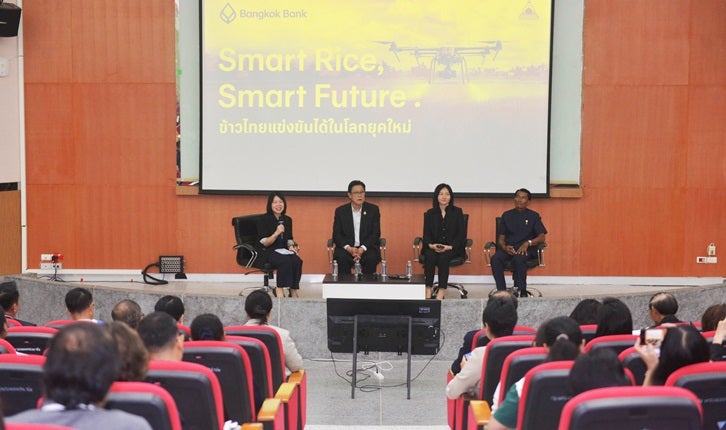

Bangkok Bank hosts “Smart Rice, Smart Future: Thai Rice Competitiveness in a New Era” with experts sharing insights while reinforcing its role as a “trusted partner and reliable close friend”, supporting sustainable growth among Thai farmers
Bangkok Bank, through its Modern Agriculture Project, joined Ubon Ratchathani University to host a seminar titled “Smart Rice, Smart Future: Thai Rice Competitiveness in a New Era”. It brought together academics and experts from agricultural and business sectors to share perspectives and explore ways to advance the future of Thailand’s rice industry through innovation, production technology and sustainable rice standards. These will increase Thai rice competitiveness in global markets and support the industry’s sustainable growth.
Bangkok Bank Executive Vice President and Head of Provincial Business Banking Prarinya Maneeprasert said Bangkok Bank’s Modern Agriculture Project joined Ubon Ratchathani University to organize the “Smart Rice, Smart Future: Thai Rice Competitiveness in a New Era” seminar as a platform for experts from academia, business and agriculture to exchange knowledge, ideas and experiences. The event also introduced approaches to enhancing the global competitiveness of Thai rice, which is no longer determined solely by production volume or quality, but also environmentally friendly production processes, traceability and compliance with sustainable rice production standards such as the Sustainable Rice Platform (SRP), which is an important mechanism for building confidence among future buyers, exporters and consumers.
“The “Smart Rice, Smart Future: Thai Rice Competitiveness in a New Era” seminar held at Ubon Ratchathani University reflects Bangkok Bank’s commitment to supporting the future of Thailand’s rice industry, one of the country’s most important economic crops. Ubon Ratchathani in particular is one of Thailand’s major rice-producing provinces, with more than 4.12 million rai of rice-growing areas and over 300,000 rice-farming households. Strengthening the capabilities of the agricultural sector in this area will contribute to the local economy and shape the direction and future of Thailand’s rice industry,” Mr. Parinya said.
Dr. Vallop Manathanya, Chairman of the Executive Committee of Bangsue Chia Meng Rice Mill, delivered a special presentation titled “The Rice Market Is Changing: How Should Thai Farmers Adapt?” He said that Thailand’s rice exports have steadily declined since 2017, in contrast with neighboring competitors such as Vietnam and India whose exports have continued to increase annually due primarily to their low prices. Thailand needs to respond quickly by reducing production costs and increasing yields per rai through improved cultivation techniques, the development of rice varieties and creation of valued-added rice including health-focused rice and low-carbon rice produced by reducing greenhouse gas emissions throughout the supply chain. Farmers also need greater access to knowledge and innovations to enhance their ability to compete while ensuring stability in their profession.
During a panel discussion titled “Advancing Thai Rice Production through Technology and Innovation”, Mr. Somsak Mauthorn, Advisor to Siam Cement Group and Chairman of KasetInno, said the main challenges facing Thai farmers are high production costs and low and inconsistent yields per rai, resulting in uncertain incomes. Siam Kubota, under Siam Cement Group, has sought to address these challenges by applying a process-control approach to farm management, starting with a better understanding of the characteristics of individual rice varieties and selecting appropriate cultivation methods. Transplanting and precision seeding, for example, allow farmers to exercise greater control over production compared with conventional casting methods. Soil analysis can also help farmers apply fertilizers more efficiently and effectively. Beyond technology, data is equally important in helping farmers make better decisions, adapt to change and stay competitive.
Asst. Prof. Supawadee Chaivivatrakul, Ph.D., Faculty of Agriculture, Ubon Ratchathani University, said that the Northeastern region faces several agricultural challenges, including sandy soil with poor water retention and low nutrient levels, variable weather conditions, high production costs, and labor shortages. She said Precision Agriculture offers a suitable approach to addressing these challenges by ensuring farming is carried out at the right place, at the right time, in the right amount, and in the right way. This includes leveling paddy fields to ensure an even surface, conducting soil analysis, using drones for field surveys and spraying, using weather forecasting applications to support decision-making, and encouraging farmers to work together and share technology to help reduce costs. Meanwhile, Mr. Ca Louy Koompan, Chairperson of the Nong Hin Rice Seed Producer Group and Chairperson of the Producer Group under the Ubon Ratchathani Rice Seed Center, encouraged farmers to form groups to gain support from government agencies and knowledge and technology from other organizations. This can help improve production quality and standards, as well as address challenges related to rice seeds, soil, water, and production costs.
At the panel discussion “New Opportunities in the Global Market: Developing Rice for Sustainability,” Associate Professor Dr. Sureeporn Katengam, Faculty of Agriculture, Ubon Ratchathani University, an expert in rice breeding, said rice varieties are a key factor determining yield, quality and the ability to cope with risks. She said the sustainable development of Thai rice varieties should address the needs of farmers, consumers and the global market. This includes developing varieties that meet market demand, offer high quality and nutritional value, and are resilient to drought, flash floods, diseases and pests. These efforts should go hand in hand with environmentally friendly production practices that reduce costs and greenhouse gas emissions, while linking varietal development with value creation and target markets. This will help strengthen the competitiveness of Thai rice and provide farmers with more stable incomes over the long term. Meanwhile, Mr. Montree Promaluksana, Team Manager, ISRL Project, said Thailand’s strength lies in its reputation as a producer of high-quality jasmine rice. To strengthen competitiveness, Thailand should therefore move toward sustainable rice (SRP) and high-value rice products, such as low-carbon rice, organic rice and health-focused rice. Production should follow standards that incorporate planning, record-keeping and traceability. At the same time, there should be clear market demand and a clear strategy to enhance the long-term competitiveness of Thai rice in the global market.
Bangkok Bank, as a “trusted partner and reliable close friend,” has continued to support the development of Thailand’s agricultural sector since 1999 through its “Modern Agriculture” program. The program aims to enhance knowledge and capabilities and build collaborative networks for Thailand’s agriculture sector and Thai entrepreneurs. Its activities include educational seminars, study visits to successful farms, and agricultural financing support. The Bank also organizes the annual “Modern Agriculture Day”, providing a platform for farmers and agricultural entrepreneurs to showcase and sell quality products directly to consumers, while creating opportunities to build networks and develop future business partnerships. The event also features seminars where experts share knowledge and perspectives on the direction of Thailand’s agricultural sector, business opportunities and challenges, as well as ways to adapt and strengthen competitiveness sustainably. Modern Agriculture Day 2026 will be held on December 25, 2026, at Bangkok Bank Head Office, Silom.
bangkokbank:assets/news/news-category/2026
2026-11-12T00:00:00
Read more
true