






Environmental Impact and Carbon Footprint Reduction
Commitment
To build employee awareness of resource and energy conservation and to implement an effective environmental and resource management system to reduce environmental impact and carbon footprint, moving toward a green organization.
Materiality
Environmental issues and climate change are becoming increasingly severe, impacting lives, health and property on a wider scale. These issues cannot be solved or mitigated by any single individual or organization alone, but necessitate the genuine cooperation of all parties, including households, businesses and the government. The Bank prioritizes energy and resource conservation, reduction of our carbon footprint and comprehensive waste management. We have implemented various projects and activities to educate employees and encourage their participation in such areas. We hope that our actions taken will contribute to the nation’s overall development efforts, leading to sustainable solutions and the achievement of national environmental and climate goals. The Bank has announced its Net Zero goal for greenhouse gas emissions from its operations (Scope 1 and Scope 2) to be achieved by 2035, and from its lending and investment (Scope 3, Category 15) to be achieved by Thailand’s target year, 2050. This Sustainability Report focuses only on disclosures of Scope 1 and Scope 2. Details relating to Scope 3 will be disclosed in the Task Force on Climate-related Financial Disclosure report on the Bank’s website.
Environmental Management and Energy Conservation
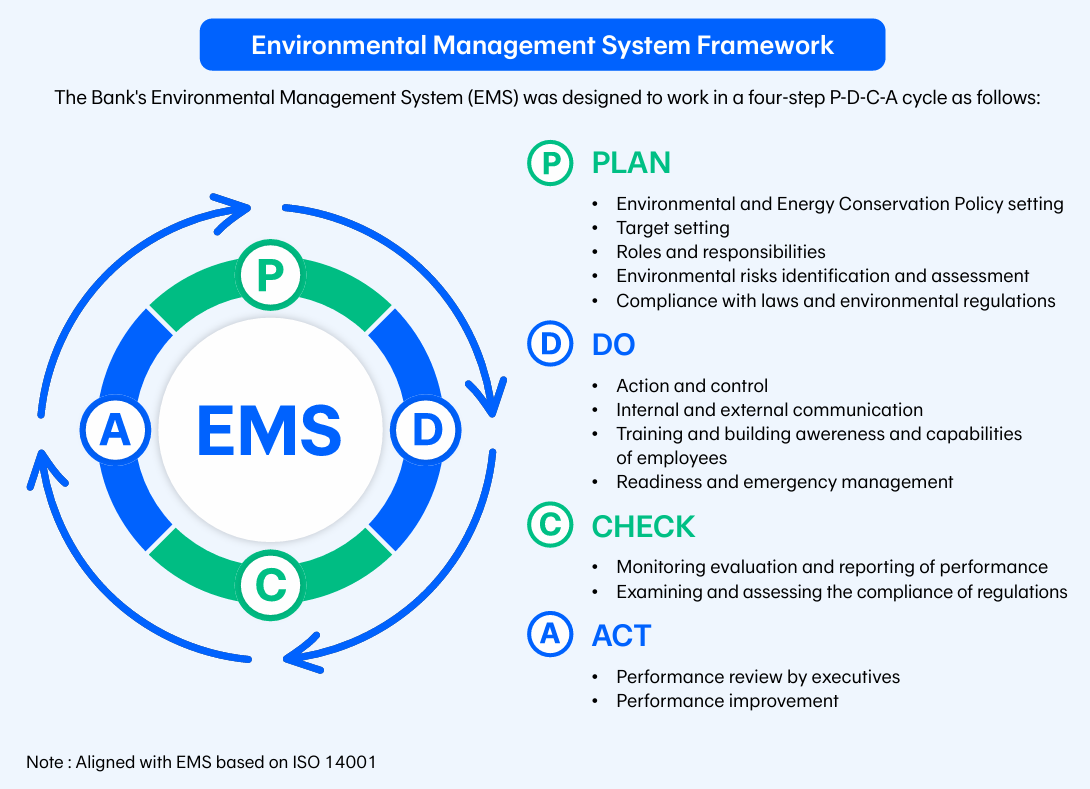
The Bank ensures systematic environmental management and energy conservation to prevent and mitigate environmental impacts from its operations by adopting international standard ISO 14001: 2015 for its environmental management and energy conservation practices. The standard covers planning, setting targets and operating plans, assessing environmental risks and impacts, monitoring performance and determining corrective measures. At the same time, we also raise awareness among employees on the matter to prevent or mitigate potential environmental impacts from the Bank’s operations.
Managing environmental issues and energy conservation efforts requires related units collaborating with each other in the form of working teams as follows:
Environment and Energy Conservation Team is responsible for ensuring effective environmental management and energy consumption of buildings, reviewing the environment and energy conservation policy, setting environment and energy conservation targets and measures, launching and driving initiatives or related activities to achieve the established targets. The team also monitors, audits and evaluates performance as well as organizes different knowledge-sharing activities.
Energy Management Team ensures that energy conservation initiatives are carried out in accordance with related laws and policies of the Bank and the implementation of energy management initiatives achieves tangible outcomes. The Bank has appointed Energy Management Teams for six designated buildings, namely the Silom head office building, Trinity Complex building, Rama 3 building, Rama 9 branch building, Si Racha branch building and Hua Lamphong branch building.
Greenhouse Gas Emissions and Absorption Analysis Reporting Team is responsible for collecting and reporting information on greenhouse gas emissions and removals from the Bank’s operations.
The Bualuang Save the Earth: 3R+ Project Working Group is responsible for overseeing the implementation of the integrated waste management project to achieve the goals, setting operational plans, coordinating within the Bank to drive the implementation, as well as monitoring the project results.
Performance Highlights
We carry out environment and energy conservation activities under our flagship Bualuang Save the Earth program that consists of various campaigns and programs, both internal and CSR activities, with shared objectives to help reduce energy and resource utilization, minimize and sort waste systematically, reduce our carbon footprint across the organization and raise awareness of and provide education on environmental and energy conservation. At the same time, we promote participation of all employees in different projects and activities to build their environmentally-responsible mindset, apply the knowledge and practices at home and share their knowledge with their family and friends.
1. Adjustment of Equipment to Enhance Energy Efficiency, Reduce Resource Utilization and Reduce Carbon Footprint
- Replacing Air Conditioners
We regularly replace air conditioners of both large and small sizes that have been used for a long time with new, more energy-efficient air conditioners using refrigerants which are not harmful to the ozone layer. In 2025 we replaced 56 air conditioners in the Silom head office building and another 120 air conditioners in 40 business centers and branches across Thailand. - Improving Lighting Systems
The Bank continuously replaces fluorescent bulbs with LED bulbs in various buildings for both offices and branches across the country. During 2025, a total of 5,216 bulbs were replaced and this is expected to reduce electricity consumption by about 456,518.70 kilowatts hour per year and reduce GHG emissions by about 228.21 tonnes of carbon dioxide equivalent per year. - Improving Toilets at the Five Head Office Buildings and Branches Nationwide
The Bank has refurbished toilets in the head office buildings (Silom head office building, Rama 3 building, Trinity Complex building, Saengthong Thani Tower and Headquarters 3) and branches across the country by gradually installing energy saving and water saving sanitaryware such as low flow water fixtures and equipment with intelligent sensors that turn on water and electricity only when in use. It is expected that the new equipment will help save more than 30 percent of water consumption compared with the original equipment. - Improving Air Conditioning System in the Head Office Buildings
The Bank replaced the fin fans in the cooling tower of the Silom head office building to improve heat exchange efficiency and reduce the workload of the air conditioning system. The newly installed fin fans are expected to reduce electricity consumption by five percent compared to the original equipment. - Installing Air Conditioning Control Equipment
The Bank has piloted the installation of an automatic air conditioning control system in Headquarters 3. This system utilizes Internet of Things technology to manage air conditioning usage, allowing for scheduled on/off times, preventing accidental changes, and ensuring precise and consistent temperature control. This helps reduce electricity consumption by approximately 15 percent.
2. Reduction of Energy, Resource Consumption and Carbon Footprint
- Bualuang Save the Earth: 3R+
We remain committed to raising awareness among employees at all levels on environmental and social issues resulting from waste and encourage their participation in waste reduction and management under the Bualuang Save the Earth: 3R+ (Reduce Reuse Recycle Plus) project. The project engages employees in the entire waste management process, from reducing waste generation and sorting waste at the workplace to reusing or recycling. The pilot phase includes the five head office buildings which are the Silom head office building, Rama 3 building, Trinity Complex building, Saengthong Thani Tower and Headquarters 3. We have implemented a waste management system that tackles waste according to its type. After sorting and collecting, each type of waste is sent for appropriate further processing. For example, recyclable waste is recycled, orphaned waste is used to create energy pellets, and food waste is used as soil conditioner.
The Bank has set a target of achieving Zero Waste to Landfill at the Rama 3 building by 2025 as the first location. The operating results show that in 2025 the amount of general waste for landfilling was reduced to only 25 percent of total waste. Although the Zero Waste to Landfill target has not yet been achieved, this is considered as a significant positive change that will inspire other buildings to follow suit in the future. The majority of the waste sent for landfilling is toilet paper. The remaining portion, which accounts for a minority of total waste, could be diverted from landfill if waste sorting is improved. In the next phase, the Bank will gradually set zero landfill waste targets for other buildings as appropriate. - Solar Cell Installation
The Bank, in collaboration with King Mongkut’s University of Technology North Bangkok, designed and renovated the campus branch under the concept of sustainable building, aiming to make it a model branch for energy and resource conservation. We supported the installation of a solar rooftop With the size of 5 kW at the Techno Park building, supplying clean electricity to the branch via a P2P system. This not only helps avoid greenhouse gas emissions but also saves approximately 17 percent on electricity costs.
Furthermore, we have the Solar Rooftop installation project at our Worachak branch as it serves as a pilot branch for reducing electricity consumption and promoting the use of renewable energy in office buildings. We installed solar panels with a total capacity of 111.54 kWp (kilowatt), the system generated a total of 292.806 GJ (Gigajoule) of electricity (January 19, 2026 to August 31, 2026) - Paperless Campaign
We have elevated and digitalized our work processes for employees under the concept, Digital Way of Work, by adopting digital technology to replace the use of A4 paper; adjusting the default setting on all printers to double-sided printing; selecting environmentally- friendly type of paper; encouraging employees to realize the value of paper; and campaigning to reduce paper use and separate and collect used paper to be sent for recycling. - Shuttle Van Service for Employees
We have arranged a shuttle van service for employees to travel between the Silom head office building, Rama 3 building, Trinity Complex building, Saengthong Thani Tower, Rama 9 building and Bang Na Sports Club to accommodate employees and reduce their transportation expenses, thereby helping reduce GHG emissions from individual transportation. - Digital Banking and Reduction of GHG Emissions
Bangkok Bank Mobile Banking and Bangkok Bank Internet Banking help facilitate customers to be able to conduct financial transactions with convenience anywhere anytime, cutting the time spent travelling to branches. This helps not only to save energy and resources but also reduce our paper usage and GHG emissions from paper production.
3. Building Awareness on Environmental and Energy Conservation
- Bualuang Saves Energy Project
We organized our annual event, Bualuang Saves Energy 2025, at the Silom head office building. The event featured activities to raise awareness of conserving energy, including environmental quizzes for participants to win prizes, presentations on innovations and technologies to reduce energy consumption, along with a special lecture on Energy Conservation Strategies for Success by an external expert. Over 500 employees attended the event. - Energy Management in Buildings Course and Energy Conservation in Buildings and Offices Course
To build awareness and promote understanding of energy conservation among employees, we developed Energy Management in Buildings and Energy Conservation in Buildings and Offices online courses through BBLearn. These covered important topics such as laws and regulations for energy conservation promotion, clean energy, ways to save energy, the Bank’s energy conservation efforts and preliminary assessment of energy management. Over 19,968 participants participated in the two courses - Bualuang Waste Management
The Bank has developed and offered a basic waste sorting course through our online learning platform, BBLearn, to build awareness of the importance of waste management and how to properly handle waste from source to disposal. This aims to help alleviate the problem of overflowing waste in cities, which has a severe impact on the environment and public health. We hope that this course will promote proper waste sorting both at work and at home. By the end of 2025, a total of 3,304 employees had attended the course. - Environmental Knowledge Sharing Seminars
The Bank continuously organizes environmental knowledge sharing seminars with a focus in 2025 on waste management, such as Ready for a Zero-Waste Lifestyle?, How to Live a Waste-Free Life and Sustainable Waste Separation with the 3 Wheels Uncle and the Missing Waste. Over 12,000 employees participated in the seminars.
4. Carbon Offsetting of the Silom Head Office Building
The Bank has continuously participated in carbon offsetting activities held by the Thailand Greenhouse Gas Management Organization (Public Organization) for many years. In 2025 the Silom head office building was certified for carbon neutrality from the purchase of carbon credits from the 133.6 MW Biothermal Generation at Mitr Phol Bio-Power, Phu Khiao (Block 2) project, totaling 11,674 tonnes of carbon dioxide equivalent.
Environmental and Resource Utilization Information
The Bank continues to systematically collect and record environmental and resource utilization data as well as carbon footprint data. We also conduct data verifications for key environmental and resource performance and consumption data as well as Scope 1 and Scope 2 GHG emissions as disclosed in this Sustainability Report. The data is verified by an external party registered with the Thailand Greenhouse Gas Management Organization (Public Organization) on an annual basis to ensure that the information disclosed by the Bank to the public is accurate and reliable in accordance with accepted standards.
Targets to reduce GHG emission from the Bank’s internal operations
|
Scope |
Baseline emissions |
Target |
2025 Performance |
||
|
Year 2025 |
Year 2027 |
Year 2030 |
|||
|
Scope 1 GHG emissions |
Base year: 2022
Base year emissions:
Percentage of emission covered by targets: 100% |
-7.5%
|
-12.5% |
-20% |
-23.26% |
|
Scope 2 GHG emission |
Base year: 2022
Base year emissions:
Percentage of emission covered by targets: 100% |
-7.5% |
-12.5% |
-20% |
-12.50% |
This Website uses cookies to provide you with the best experience and to improve the Bank’s website services in order to better serve your requirements. You can find the details about cookies use on
Cookies Policy