




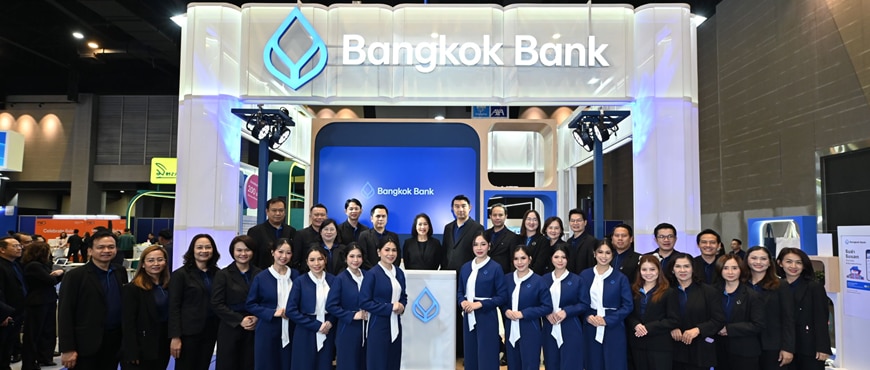



Bangkok Bank unveiled five megatrends shaping the ‘new ASEAN’ at its annual flagship event, the ‘AEC Business Forum 2026’. These covered challenges arising from geopolitical tensions, shifts in global trade, technological transformation, climate change, and demographic changes. The forum explored opportunities to collaborate and position ASEAN as a rising economic star, while inviting senior executives from leading global companies to share perspectives, ideas, and strategies for sustainable success.
Bangkok Bank President Mr. Chartsiri Sophonpanich delivered his opening speech ‘New ASEAN: A Paradigm Shift’ which addressed how the world throughout 2026 will continue to face risks, volatility, and uncertainty driven by five critical factors—each of which present challenges and opportunities that will define ASEAN’s future:
- Balance and foster international cooperation to strengthen regional economies. For Thailand, the Bank of Thailand has promoted the use of the baht and other local currencies in cross-border trade to reduce reliance on the U.S. dollar, while enhancing financial cooperation, investment connectivity, and payment systems across ASEAN. These efforts will help Thai businesses access a larger market of over 660 million people with a combined GDP of more than USD 4.25 trillion.
- Shifts in global trade - ASEAN is becoming a key player in a multipolar global trade
system supported by its large market and economy, which is expected to rank fourth globally by 2030, along with a vast labor force and strategic location for global supply chains. Foreign direct investment (FDI) has surged from 5% a decade ago to 20% in 2024, targeting countries such as Vietnam, Indonesia, Thailand, Malaysia, Singapore, and the Philippines, particularly in strategic industries like semiconductors, electric vehicles, data centers, and biotechnology.
- Technological transformation - ASEAN is advancing toward becoming a hub for technology
innovation, driven by a digital-savvy population and new investments in areas such as Artificial Intelligence (AI), data centers, and advanced manufacturing which lead to growth in many sectors. Singapore aims to position itself as a global AI hub, hosting over 1,000 AI startups and serving as a base for leading tech firms such as OpenAI, Google, and NVIDIA. Meanwhile, other ASEAN nations are implementing their own AI strategies. However, SMEs—the backbone of regional economies—are facing pressure from rapid market and technology shifts and are in need of support to accelerate their digital transformation.
- Climate change – New global regulations such as the EU’s Carbon Border Adjustment Mechanism (CBAM) and Deforestation Regulation (EUDR) are moving trade toward low-carbon supply chains. Businesses must adapt and create long-term plans for their transition to net zero. This shift also presents ASEAN with the opportunity to lead the world in sustainable growth.
- Demographic change Singapore and Thailand are aging rapidly, creating labor shortages in the agriculture sector. The region must attract younger generations back to farming and leverage modern technologies such as AI to boost productivity and maintain ASEAN’s role as a leading global food producer.
“ASEAN is entering a new era filled with challenges in geopolitics, trade, technology, climate change, and demographic change. Nevertheless, each of these factors offers opportunities to enhance competitiveness. If member countries strengthen cooperation, harness megatrends, and invest in green technology, digital innovation, and workforce skills, ASEAN can become one of the world’s most attractive investment destinations. Collaboration is key to turning uncertainty into a driving force for the region’s future. As a leading regional financial institution, Bangkok Bank is committed to supporting customers through its presence in nine of the 11 ASEAN countries, enabling them to seize new opportunities and achieve sustainable growth,” said Mr. Chartsiri.
The forum also featured keynote speeches and panel discussions with distinguished leaders. Secretary-General of the Board of Investment Mr. Narit Therdsteerasukdi delivered a keynote on “The New ASEAN Economy: Future-Focused Thailand, Opportunities in Emerging Industries.” The panel discussion on “ASEAN’s Next Wave: New Sector Opportunities to Capture Global FDI” was joined by Mrs. Somruedee Chaimongkol, Senior Executive Committee and Former CEO of Banpu, Mr. Lim Hua Tiong, CEO of Frasers Property (Thailand) and Frasers Property Limited’s Emerging Markets, Asia portfolio, Mr. Yeap Swee Chuan, Executive Director AAPICO Hitech, and Mr. Teddy Nuryanto Oetomo, President Director Merdeka Battery Materials.
Speakers for the panel discussion on “Navigating Trade Fragmentation in a Geopolitical Era,” included Mr. Vasit Taepaisitphongse, CEO of Betagro, Mr. Abhijit Datta, former Managing Director & Head of International Business, SCG International Corporation and Advisor at SCG Distribution & Retail, and Director SAMEA, SCG International, and Dr. Kobsak Pootrakul, Senior Executive Vice President of Bangkok Bank. Meanwhile, the panel discussion on “Strategies for Success in the Age of Tech Fragmentation” featured Mr. Dipen Mehta, Managing Director, Asia Financial Services of Microsoft, Dr. Chawapol Jariyawiroj, President of Huawei Technologies (Thailand), and Dr. Buranin Rattanasombat, Chief New Business and Sustainability Officer, PTT, who shared insights, experiences, and strategies for business success.
The 7th ‘AEC Business Forum 2026’, under the theme ‘New ASEAN: A Paradigm Shift’, was held on Wednesday, January 14, 2026, at Centara Grand and Bangkok Convention Centre, CentralWorld.